
Mineral exploration is much more than drilling holes into the ground. Before any drill rig arrives on site, exploration companies invest significant time in geological studies, survey planning, and target evaluation to maximize the chances of discovering economically viable mineral deposits. Every stage of the exploration process contributes valuable information, helping geologists reduce uncertainty before making major investment decisions.
Among the many activities involved in mineral exploration, Drilling Services play one of the most critical roles. Drilling provides direct access to subsurface geology, allowing exploration teams to recover physical rock samples that verify geological models and reveal the characteristics of potential mineral deposits.
However, drilling itself is only one part of a much larger exploration workflow. From planning and geophysical surveys to core logging and laboratory analysis, every step contributes to building a reliable geological model that supports resource estimation and future mine development.
This guide explains the complete exploration drilling process, highlighting how professional Drilling Services support modern mineral exploration and why high-quality geological data remains essential for successful exploration projects.
What Is Exploration Drilling?
Exploration drilling is the process of drilling boreholes to investigate underground geological conditions and determine whether economically valuable mineral deposits are present. Unlike production drilling, which is performed to extract ore, exploration drilling is carried out to collect geological information. The primary objective is to understand what lies beneath the surface by recovering samples that help geologists identify rock types, mineralization, alteration, structural features, and other characteristics of the subsurface.
The information obtained through exploration drilling supports important decisions throughout a mining project’s lifecycle, including resource estimation, mine planning, metallurgical testing, and geotechnical evaluation. Professional Drilling Services therefore provide much more than drilling they generate the geological data that forms the foundation of exploration decision-making.
Stage 1: Geological Planning Before Drilling Begins
Exploration companies typically start by reviewing available geological information, historical exploration data, satellite imagery, and regional geological maps. These early studies help identify areas with favorable geological characteristics while reducing unnecessary drilling in low-potential locations.
Planning also involves environmental assessments, land access coordination, safety planning, logistics, and budgeting. Because drilling often takes place in remote locations, careful preparation helps minimize operational delays and ensures exploration activities comply with applicable regulations.
This planning stage allows exploration teams to focus their Drilling Services on areas where geological evidence suggests the greatest exploration potential.
Stage 2: Target Generation Using Geological and Geophysical Data
Before selecting drill locations, geologists integrate multiple exploration datasets to identify promising subsurface targets. Common exploration methods include:
- Geological mapping
- Geochemical sampling
- Remote sensing
- Magnetic surveys
- Gravity surveys
- CSAMT surveys
For example, a CSAMT Survey can image underground resistivity variations associated with geological structures such as faults, hydrothermal alteration zones, and intrusive contacts. These structures often control mineralization and help exploration teams identify where drilling should be concentrated. Rather than drilling randomly, modern exploration uses these datasets to reduce uncertainty and improve drilling efficiency.
Stage 3: Designing the Drilling Program
Once exploration targets have been identified, geologists design the drilling program to answer specific geological questions. Important planning decisions include:
- Drill collar locations
- Borehole orientation
- Inclination angle
- Target depth
- Hole spacing
- Sampling intervals
- Appropriate drilling method
Each borehole is carefully positioned to maximize geological information while minimizing unnecessary drilling costs. The selected Drilling Services should always match the exploration objectives rather than simply prioritizing speed or cost.
Stage 4: Choosing the Right Drilling Method
Reverse Circulation drilling is often selected for rapid exploration and geochemical sampling because it efficiently produces representative rock chip samples across large exploration areas.
Rotary drilling is commonly used for applications such as water wells, blast holes, infrastructure projects, and certain preliminary investigations where continuous geological samples are not required. For advanced mineral exploration, however, diamond core drilling is generally the preferred solution. Unlike other drilling methods, diamond core drilling recovers continuous cylindrical rock samples that preserve geological structures, mineralization, fractures, veins, and alteration patterns. This level of detail makes it the preferred choice for resource definition, structural interpretation, metallurgical testing, and geotechnical investigations.
For this reason, many advanced Drilling Services focus on diamond core recovery when high-quality geological information is essential.
Stage 5: Mobilization and Site Preparation
Before drilling begins, the exploration team prepares the site for safe and efficient operations. This stage typically includes transporting drilling equipment to the project area, constructing drill pads, establishing water supply systems, inspecting equipment, implementing environmental controls, and conducting safety briefings for all personnel. Although often overlooked, proper mobilization plays an important role in maintaining drilling efficiency and minimizing operational risks throughout the project.
Stage 6: Drilling Operations
Once preparations are complete, drilling operations begin. For diamond core drilling, a drill rig rotates a diamond-impregnated drill bit that cuts around the rock to recover an intact cylindrical core. As drilling progresses, drilling fluids cool the drill bit, stabilize the borehole, and remove cuttings generated during the drilling process. The recovered core is stored inside a core barrel and periodically retrieved to the surface using a wireline system.
Accurate depth recording, careful handling of core, and consistent drilling procedures are essential to maintaining sample quality throughout the drilling campaign. Professional Drilling Services place significant emphasis on these operational standards because the quality of drilling directly affects the reliability of geological interpretation.
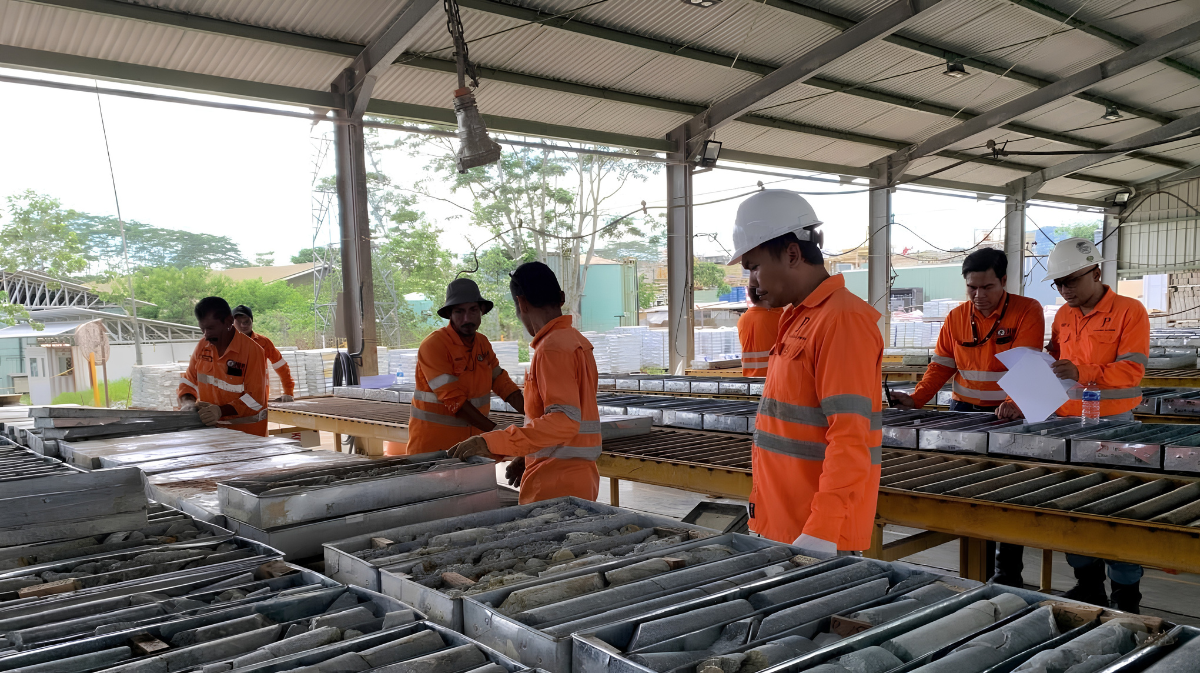
Stage 7: Core Recovery and Geological Logging
One of the most important indicators of drilling quality is core recovery, which measures the percentage of drilled rock successfully recovered to the surface. High core recovery allows geologists to build more complete geological models while increasing confidence in exploration results. After retrieval, each core is placed into labeled core trays and examined by experienced geologists.
During core logging, geologists record:
- Lithology
- Mineralization
- Hydrothermal alteration
- Vein distribution
- Faults and fractures
- Weathering
- Structural orientation
- Rock Quality Designation (RQD)
This detailed logging transforms physical rock samples into geological information that supports exploration decision-making.
Stage 8: Core Sampling and Laboratory Analysis
After geological logging is complete, selected intervals of drill core are prepared for laboratory analysis. A common industry practice is to cut the core lengthwise, with one half sent for laboratory testing while the remaining half is retained for future reference and verification. Laboratories analyze the samples to determine concentrations of valuable elements such as gold, copper, nickel, silver, and other commodities depending on the exploration target.
To maintain data quality, exploration programs implement rigorous quality assurance and quality control (QA/QC) procedures, including certified reference materials, blanks, duplicates, and standardized sampling protocols. Reliable laboratory results are essential because they provide the analytical evidence used for resource evaluation and geological modeling.
Stage 9: Geological Interpretation and Resource Evaluation
Geologists integrate drilling data with geological mapping, geophysical surveys, geochemical information, and laboratory assays to build three-dimensional geological models of the deposit.
These models help define:
- Mineralized zones
- Ore body geometry
- Structural controls
- Alteration patterns
- Resource boundaries
The resulting interpretation supports mineral resource estimation and provides the technical foundation for future exploration, feasibility studies, and potential mine development. Recognized international reporting frameworks under the CRIRSCO family emphasize representative sampling, documented geological logging, and reliable drilling practices, which is one of the reasons diamond core drilling remains widely used during advanced exploration.
Exploration Drilling in Indonesia
Indonesia is one of the world’s leading producers of nickel and an important producer of gold, copper, tin, and other mineral commodities. As exploration activities continue across regions such as Papua, Sulawesi, Halmahera, Sumatra, and Nusa Tenggara, high-quality Drilling Services remain essential for evaluating increasingly complex geological environments.
Many exploration programs combine geological mapping, geophysical surveys, and diamond core drilling to improve confidence before major investment decisions are made. This integrated approach allows exploration teams to better understand subsurface conditions while reducing exploration risk.
How Puncakbaru Jayatama Supports Exploration Projects
Every exploration project requires dependable geological information to support informed decision-making. At Puncakbaru Jayatama (PTPJ), professional Drilling Services are designed to support mineral exploration through high-quality diamond core drilling, reliable core recovery, and accurate geological data collection. Our drilling team has proven experience working in some of the most challenging exploration environments, allowing us to adapt our operations to demanding terrain and field conditions across Indonesia.
Working alongside geological mapping, geophysical investigations, laboratory analysis, and exploration planning, PTPJ helps clients develop a clearer understanding of subsurface conditions while supporting efficient and responsible exploration programs across Indonesia.
Frequently Asked Questions
What is exploration drilling?
Exploration drilling is the process of drilling boreholes to investigate underground geology and collect samples that help determine whether economically valuable mineral deposits are present.
Why is planning important before drilling?
Planning helps identify the most prospective drilling targets, reduces unnecessary drilling, improves safety, and optimizes exploration budgets.
What happens after drill core is recovered?
Recovered core is logged by geologists, photographed, sampled, and sent to laboratories for geochemical analysis before being incorporated into geological models.
Why is diamond core drilling preferred for mineral exploration?
Diamond core drilling recovers continuous rock samples that preserve geological structures, mineralization, and alteration, making it the preferred method for detailed geological interpretation and resource estimation.
How do geophysical surveys support drilling?
Geophysical surveys such as CSAMT help identify subsurface geological structures before drilling, allowing exploration teams to prioritize the most promising targets and improve drilling efficiency.
Conclusion
Exploration drilling is a carefully planned process that transforms geological concepts into measurable evidence beneath the surface. From early-stage geological studies and target generation to drilling operations, core logging, laboratory analysis, and resource evaluation, every stage contributes valuable information that improves exploration confidence.
Among the available Drilling Services, diamond core drilling continues to play a central role because it provides the continuous geological information required for structural interpretation, resource estimation, metallurgical testing, and long-term exploration success.
When integrated with geological mapping, geophysical surveys, and laboratory analysis, professional drilling programs help exploration companies reduce uncertainty, improve decision-making, and build stronger geological models that support responsible mineral development.
Build Stronger Exploration Programs with PTPJ’s Drilling Services
If your mineral exploration project requires reliable geological information and professional Drilling Services, Puncakbaru Jayatama (PTPJ) provides experienced diamond core drilling solutions tailored to Indonesia’s diverse geological conditions.
From exploration planning and drilling operations to core recovery and geological support, our team is committed to delivering high-quality data that helps clients make informed exploration decisions. Contact PTPJ today to learn how our drilling expertise can support your next mineral exploration project.